LVT’s Lindsey: Public backs AI surveillance, with clear limits on privacy and data use Survey shows strong support for AI cameras tied to crime prevention, but concerns persist around tracking and transparency

By Cory Harris, Editor
Updated 11:48 AM CDT, Wed June 10, 2026
 AMERICAN FORK, Utah—As debate around artificial intelligence (AI)-driven surveillance intensifies across the security industry and public policy circles, new research suggests the public isn’t rejecting the technology outright – but is instead drawing clearer boundaries around how it should be used.
“I don’t think people are generally against these technologies,” said Steve Lindsey, chief strategist at LiveView Technologies (LVT). “I think what they’re against is misuse.”
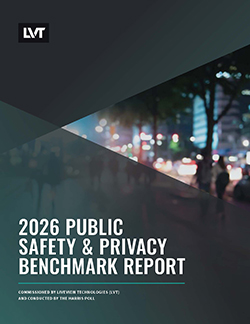
That perspective reflects findings from LVT’s 2026 Public Safety & Privacy Benchmark, conducted by The Harris Poll, which shows broad support for AI-enabled cameras, facial recognition and automated license plate recognition (ALPR) when tied to crime prevention – but concern when those tools extend into tracking or unclear data practices.
Acceptance hinges on use case
 The survey of 2,089 U.S. adults found that 60% support AI-enabled cameras to detect suspicious behavior, while 79% say facial recognition is acceptable for identifying known violent offenders. Support for ALPR is similarly strong, with 78% saying it makes parking areas feel safer.
Still, Lindsey emphasized that acceptance is conditional and tied directly to purpose.
“It’s not that the technology isn’t useful,” he said. “People see the value in solving crimes. What they’re concerned about is how long data is retained, who has access to it, and how it’s used.”
Tracking concerns remain central
Lindsey said the clearest line the public draws is around tracking – particularly across multiple locations or over extended periods.
“Most people don’t want to be tracked,” he said. “That’s where concerns start.”
That sentiment is reflected in strong expectations around data governance. A majority of respondents said non-suspicious ALPR data should be deleted within 30 days or less, and nearly half said the same for video footage when no crime is detected, policies Lindsey said are fully achievable with modern systems.
Transparency is also key. Eighty-seven percent said the public should be clearly notified when ALPR systems are in use, underscoring the importance of clear communication.
Trust in video - and demand for control
The study also highlights strong trust in video evidence, with respondents indicating they would rely on footage more than eyewitness accounts if a crime occurs.
“There’s a general feeling people trust what the camera shows,” Lindsey said.
At the same time, 74% support the ability to turn AI features on or off, reflecting demand for greater user control and flexibility based on risk tolerance.
“There has to be that ability to decide what you use and what you don’t,” Lindsey said.
“Just because you can do something doesn’t mean you should.”
He also pointed to cybersecurity as a key, and often overlooked, component of responsible deployment.
Safety concerns shaping behavior
The findings come as safety concerns continue to influence behavior. One in five Americans said they feel unsafe during the day in places such as parking lots and outdoor events, while 81% said they would avoid at least one type of public space at night.
Those concerns extend to civic participation, with 45% saying they avoided at least one political or civic activity due to fears of confrontation or intimidation.
Lindsey said the industry now faces a critical moment as adoption accelerates.
“If we use this technology the right way, it can improve safety and confidence,” he said. “If we don’t, we risk losing trust.”
Photo courtesy of LiveView Technologies

Comments