Eluviant sees generative AI driving next phase of video intelligence Rebranding from IntelexVision, company says it's ‘Not just about seeing; it's about understanding'

By Cory Harris, Editor
Updated 11:16 AM CDT, Wed August 5, 2026
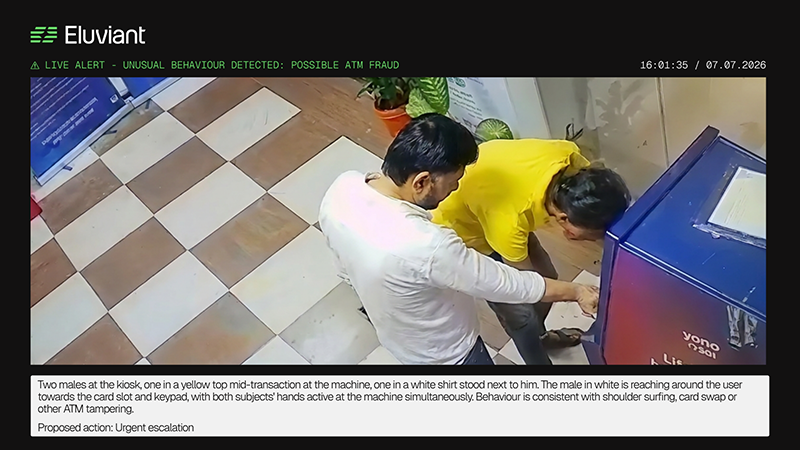
LONDON—As security providers race to incorporate generative AI into video surveillance, Eluviant believes the technology's greatest value lies not in identifying objects, but in understanding behavior.
The company, formerly known as IntelexVision, recently launched Aurora Flow, a generative AI capability designed to analyze events as they unfold over time rather than evaluate individual video frames in isolation.
.jpg) According to founder and co-CEO Callum Wilson, that shift could help security teams reduce nuisance alerts, improve incident detection and extract greater value from existing camera systems.
According to founder and co-CEO Callum Wilson, that shift could help security teams reduce nuisance alerts, improve incident detection and extract greater value from existing camera systems.
"What we're doing is taking a snippet of time and understanding it as a sequence of events across time," Wilson said. "The context is therefore understood."
Beyond frame-by-frame analytics
Wilson said the technology is particularly valuable when distinguishing between similar-looking situations that require vastly different responses.
"To tell horseplay versus a genuine fight or a mugging is completely impossible on the frame level," he said. "This gives us the ability to differentiate those things."
The launch also coincides with the company's rebrand from IntelexVision to Eluviant, a move Wilson said reflects the evolution of both the technology and the company's long-term vision.
"The IntelexVision name is where we came from in the past, and Eluviant is where we're trying to go to," he said. "It's not just about seeing; it's about understanding."
Cutting through alert fatigue
At the operational level, Wilson said Aurora Flow is helping organizations significantly reduce alert volumes.
In one large shopping mall deployment, a system that generated roughly 4,000 events over a three-day period was filtered down to about 100 incidents using traditional methods. Aurora Flow further reduced that number to eight actionable events.
"It gives us less events, but the right ones," he said.
Wilson believes the technology can also help address one of video analytics' longstanding challenges: reducing false alarms without increasing the risk of missed incidents.
"There is a fundamental tension that always exists inside video analytics," he said. "The greater the effort to reduce false positives, the greater the risk that you miss something."
According to Wilson, Eluviant incorporates generative AI directly into the decision-making process instead of using it only to explain events after they have already been detected.
"What we try to do is put it right in the decision-making loop so the event isn't generated until the generative AI has done its job," he said.
Preserving existing investments
The company is also positioning the technology as an overlay to existing security infrastructure rather than a replacement. Wilson said Eluviant integrates with major video management systems, including Genetec and Milestone, and is designed to work with customers' existing camera deployments.
"We are completely VMS and camera agnostic," he said.
Humans remain central
Looking ahead, Wilson expects AI to continue reshaping security operations, but he does not believe human operators will disappear from the equation. Instead, he expects operators to spend less time monitoring screens and more time evaluating incidents and making decisions.
"Humans are not going to go anywhere," Wilson said. "But their role will continue to change."
Related: IntelexVision rebrands as Eluviant, launches Aurora Flow AI model
Photo courtesy of Eluviant

Comments