Smarter security: Why automation needs AI - and humans Experts at ISC East warn that automation without oversight and education leaves critical gaps

By Cory Harris, Editor
Updated 12:14 PM CST, Thu December 11, 2025
NEW YORK— As cyber and physical threats converge, security automation is no longer optional, it’s essential, according to industry experts.
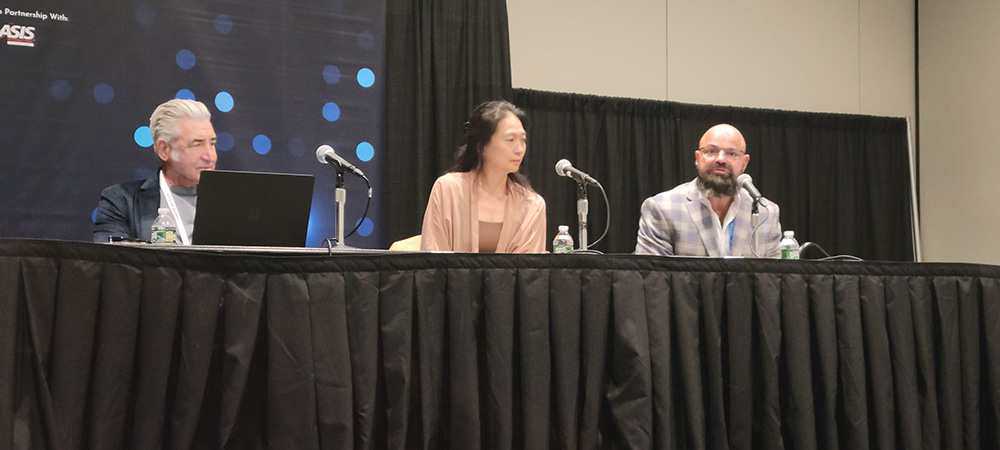
That was the focus of a session at ISC East 2025 titled, “Security Automation for Cyber-Hardened Facilities,” that explored how automation, AI and human oversight intersect to create resilient operations. Moderated by Brittany Board, director of technology partners at PSA Security Network, the panel featured:
- Min Kyriannis, CEO of Amyna Systems;
- Gary Hoffner, vice president of PSLA; and
- Stephen Oliva, OEM Partner Development & Western U.S. sales manager at Altronix
Automation defined - now with AI
 Kyriannis defined AI as “deep machine learning” - a tool for discovery and pattern recognition that speeds up processes and decision-making. She noted that AI does not replace human judgment; rather, it relies on people to validate outcomes. While AI helps identify vulnerabilities and optimize responses, adversaries exploit the same patterns, making human oversight critical.
“Humans are the ones deciding what has to happen,” she said. “I think if a human is saying, well, this is susceptible for it to come in, guess what? The model is going to learn it and say, well, this is legit. I think there's a balance here that we've got to talk about with automation and deep machine learning, or what we call AI.”
With thousands of processes and messages to manage daily, Olivia noted that automation and AI will play a key role in securing data centers, especially as legacy analog devices are brought online and integrated into modern platforms. While AI will handle complexity, human oversight will remain essential.
“AI will help manage that - still with a human touch,” he said.
Education: The human factor
Security automation promises speed and scalability, but success depends on risk-based playbooks, human oversight, and continuous education. Kyriannis noted that technology investments fail without proper training.
“Training and education are very, very key,” she said. “Automation is great to a point because it can do a lot of things for us, but we can become complacent. People have to understand what the risks are. Technology is great, but we have to educate ourselves on how to use it and what safety mechanisms are in place.”
Future outlook
Looking at the future of automation, Hoffner said that “AI has turned security from a reactive, manpower-heavy function into a predictive, data-driven discipline. Adopting AI across physical and cybersecurity offers clear visibility, faster response, reduces operator burden, and makes it more secure.”
Kyriannis noted that caution remains. “Bad data in, bad data out - make sure the data you’re taking out is the right data you’re supposed to be looking at,” she said. “Otherwise, you are not going to get the factual data.”
Oliva simply stated, “Start talking about automation now and plan for it. Whether you’re a manufacturer, integrator, or end user, it has to be talked about.”

Comments