Specifically Speaking: Bryant Schrader on complexity of hospitality, gaming verticals What's the best way to integrate surveillance and emerging tech in high-demand environments?

By Cory Harris, Editor
Updated 1:35 PM CDT, Wed September 24, 2025

MILWAUKEE—Bryant Schrader, a technology design hospitality manager at EXP, is helping lead the charge as the demand for smarter, more integrated security systems grows across the hospitality and gaming sectors.
Schrader oversees a team designing low-voltage systems for high-profile projects like Harrah’s Cherokee Casino and Spirit Airlines’ headquarters, blending aesthetics, regulation and cutting-edge tech into seamless security solutions.
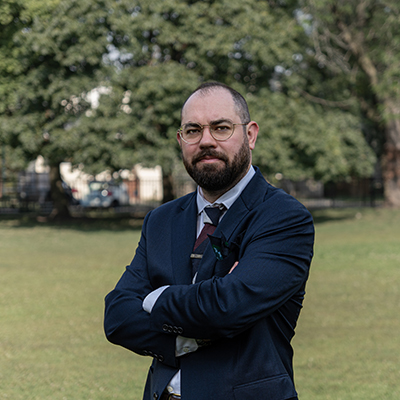 “I manage a team of designers, serve as the lead designer on multiple projects, contribute to teaching initiatives and support the development of standards within the Technology Design group,” Schrader said.
As part of Security Systems News’ monthly column Specifically Speaking, the following is an exclusive Q&A with Schrader.
SSN: What kinds of systems do you design/specify and what services does the company provide?
Schrader: EXP’s Technology Design group designs and specifies structured cabling systems, audio/visual systems and surveillance/security systems. We also provide consulting services on numerous active equipment systems, including wireless systems, PON (passive optical network) and other network deployments, and surveillance servers and storage, as well as new technologies that integrate with security systems.
EXP delivers a vast range of services across markets and geographies, including earth and environment, industrial and chemical, infrastructure, program and project delivery and operations.
SSN: What vertical markets does the company specialize in?
Schrader: EXP specializes in entertainment and sports, hospitality and gaming, transportation, federal, education, mission critical, health care, science and technology, and civil and cultural markets across North America and beyond.
I specialize in designing hospitality and gaming projects. I find casinos to be very interesting projects due to the density of low voltage systems within them. The placement of devices and systems requires careful consideration due to aesthetics. To add to the level of complexity, every state and Indigenous Community has different regulations and traditions, which alter the design process.
SSN: How did you get started in security and designing/specifying?
Schrader: I have a degree in architectural engineering, specializing in electrical design from the Milwaukee School of Engineering. I found low-voltage systems interesting, as technology is constantly evolving, which impacts the design process.
I started at EXP in 2007 as an intern and was exposed to many projects, and shortly after, I focused on casinos and hotels. The transition into casinos prompted an immediate need to thoroughly understand the surveillance and security requirements integral to hospitality projects. From there, I found my niche, and I’ve expanded my portfolio of projects and application of technology design.
SSN: What new or emerging technologies are you seeing or specifying today?
Schrader: We’re seeing a slight increase in conversations with owners around the planning and use of robots and drones. Hospitality robots need to integrate into the security systems to allow for the robot’s movement. Drones require a landing pad and additional infrastructure.
For casino designs, there’s a strong preference for on-premise surveillance storage. Improved video compressions are great for reducing storage footprint requiring less cooling and less power. This allows us to lean into higher resolution and capabilities within individual cameras.
SSN: What is your view on the industry moving forward?
Schrader: From a consulting perspective, it can be challenging to determine how far to develop a design and where that handshake between the designers and contractors occurs. It is more important than ever to have a designer involved in a project from schematic design through building occupancy and to have an open conversation between the consultant, integrator and owner throughout the entire project.

Comments