Industry leaders warn: Cybersecurity is now the foundation of intelligent security

By Cory Harris, Editor
Updated 9:37 AM CDT, Wed April 1, 2026
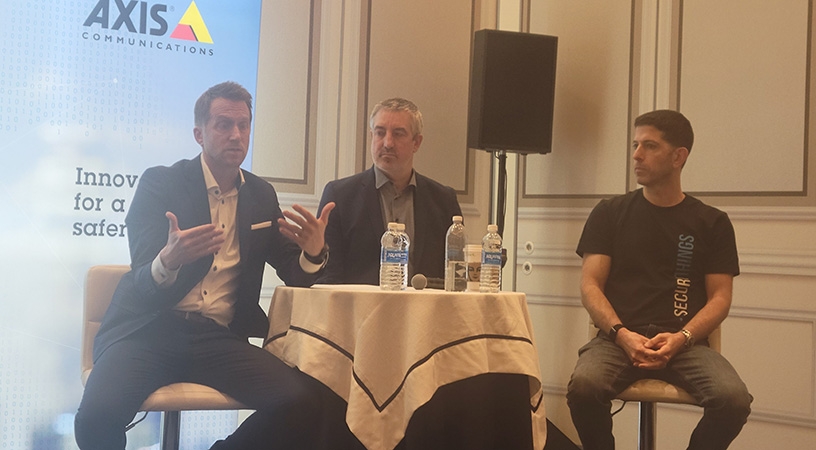
LAS VEGAS—Industry leaders recently underscored how legacy security practices are colliding with enterprise information technology (IT) expectations, zero-trust architectures and artificial intelligence (AI)-driven use cases, demanding tighter control across devices, networks and data.
That was the message from a panel discussion hosted by Axis Communications during its Media Breakfast at ISC West. The panel featured:
- Eric Yunag, executive vice president of products and services at Convergint;
- Tim Vanevenhoven, senior director of business development and strategic partnerships at HPE Networking; and
- Roy Dagan, CEO of SecuriThings.
Leaving the ‘run-to-fail’ mindset behind
Yunag said many organizations are only beginning to come to terms with the cybersecurity risks created by decades-old physical security infrastructure.
“For a long time, our industry lived in a run-to-fail mindset,” he said. “If the camera is recording and the door opens, devices stay on the wall.”
That approach, he said, is incompatible with an AI-enabled future that requires broader connectivity and greater reliance on networked devices. As more cameras, readers and sensors come online, the attack surface grows, making lifecycle management nonoptional.
Zero trust moves to the forefront
From a network perspective, Vanevenhoven described zero trust as an essential framework for securing modern physical security environments.
He outlined the need for device authentication, least-privilege access through network segmentation, and continuous monitoring.
“If you can’t identify what’s on the network, you can’t secure it,” he said. “Hope isn’t a strategy. It’s not if you get hacked - it’s when.”
Treating security devices as IT assets
Dagan emphasized that physical security devices must now be managed like enterprise IT endpoints - not static hardware.
He said organizations are increasingly aware of cybersecurity and compliance gaps in their physical security infrastructure and are looking to ecosystem partners to help automate updates, credential management and configuration compliance at scale.
“These are proper enterprise IT devices,” he said. “They have to be secured, managed and maintained continuously.”
Integrators as cybersecurity advisors
As traditional hardware margins shrink and security environments grow more complex, integrators are increasingly expected to act as strategic advisors - helping customers navigate cybersecurity, network architecture and long-term technology planning.
“If cybersecurity isn’t foundational to consulting, design and planning right now, organizations will end up in the wrong place in just a few years,” Yunag said.
Yunag described the industry’s transition from a traditional linear “channel” model to a more interconnected value-chain approach, where manufacturers, software providers, networking firms and integrators must work more closely together.
“This level of complexity can’t be solved by one party alone,” he said.
Cybersecurity as duty of care
When the discussion turned to accountability, the panel framed cybersecurity less as a question of blame and more as one of organizational alignment. Dagan noted that many physical security teams think in terms of compliance rather than cybersecurity - and that mindset can help drive alignment with enterprise standards.
Yunag compared cybersecurity expectations to legal or human resources (HR) compliance: Physical security leaders are not expected to be technical experts but must align with IT and cybersecurity teams.
“The mandate remains the same – business continuity, duty of care and risk mitigation,” he said. “Cybersecurity is now inseparable from that responsibility.”

Comments