Security’s next chapter: Capital, AI and confidence Industry leaders see strong tailwinds - from investment and consolidation to smarter AI adoption - shaping security’s outlook

By Cory Harris, Editor
Updated 12:58 PM CDT, Wed April 22, 2026
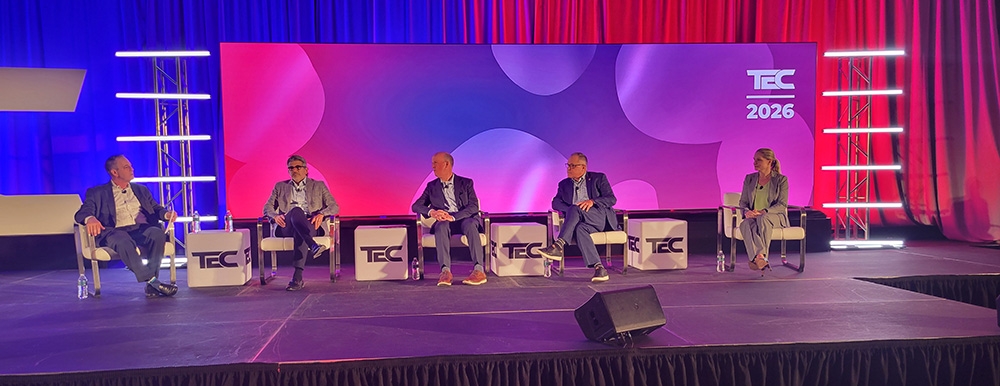
DENVER—From accelerating artificial intelligence (AI) adoption to rising private equity interest, security thought leaders say the industry is heading into 2026 with strong momentum - and higher expectations.
That message came through during PSA TEC’s State of the Industry panel moderated by Matt Barnette, president and CEO of The PSA Network. The panel featured experts from capital markets, associations, integration and manufacturing.
Capital markets remain “bullish”
.jpg) From an investment standpoint, Alper Cetingok, senior managing partner at Raymond James, said security continues to stand out as a “resilient” sector.
From an investment standpoint, Alper Cetingok, senior managing partner at Raymond James, said security continues to stand out as a “resilient” sector.
“This is a very healthy point in time for the industry,” Cetingok said, citing sustained demand, consolidation and capital inflows. “We’re arguably more bullish today than we were a few years ago.”
Security integration remains highly fragmented, with roughly 70% of providers still small or mid-sized. That fragmentation, Cetingok said, is accelerating mergers and acquisitions (M&A) as larger companies pursue scale, geographic reach and broader capabilities. Valuations for integration businesses have risen meaningfully in recent years.
Private equity remains a central driver. “There’s a belief you don’t lose capital in security,” Cetingok said, pointing to the industry’s defensive and countercyclical attributes.
Integrators see healthier demand
From the integrator’s perspective, John Petruzzi, CEO of Unlimited Technology, said conditions on the ground appear equally strong.
“We just had a record first quarter from a bookings perspective heading into Q2,” Petruzzi said. Customers, he added, are increasingly focused on outcomes and long‑term value rather than lowest price.
That shift is helping integrators move clients toward negotiated work, service contracts and recurring revenue models as system complexity grows.
“You have to level‑set expectations,” Petruzzi said. “Every camera or door can’t be treated as mission critical, or the economics don’t work.”
Petruzzi also highlighted growing use of AI within integrator operations - particularly supporting sales, engineering and back‑office functions - emphasizing efficiency and scalability, not workforce reduction.
AI moves beyond the buzz
From the manufacturing side, Heather Torrey - who represented Honeywell as GM of commercial security before taking on her new role as executive vice president for the Americas at dormakaba - said the industry is moving past AI hype toward practical applications.
“Two years ago, it was ‘AI, AI, AI,’” Torrey said. “Now it’s really about outcomes.”
Manufacturers are embedding AI to improve decision‑making, efficiency and user experience while maintaining human oversight. Torrey also stressed the importance of open platforms and interoperability as customers increasingly blend technologies across ecosystems.
Regulatory issues loom
Despite the optimistic outlook, Don Erickson, CEO of the Security Industry Association (SIA), cautioned that regulatory pressures remain a concern.
He highlighted ongoing efforts related to the lower 900 MHz spectrum, warning that a proposal by NextNav before the Federal Communications Commission (FCC) could create interference risks for unlicensed wireless security devices.
“This isn’t just a residential issue,” Erickson said. “It affects commercial systems and public safety.”
He also pointed to funding opportunities at the state level, particularly for K–12 school security and other critical infrastructure projects.
Talent remains a top challenge
Even with strong demand, workforce development continues to be the industry’s most pressing long‑term challenge. Panelists stressed training, education and retention strategies.
“Technology is changing fast, and so is our workforce,” Torrey said, urging integrators to leverage manufacturers and associations for resources.
Erickson highlighted the Foundation for Advancing Security Talent (FAST), which focuses on compensation benchmarks, career pathways and future skill requirements.
Looking ahead, Cetingok urged integrators to plan proactively.
“The idea that this is a slow, sleepy industry is gone,” he said. “The pace of change is only accelerating.”

Comments