SGT certifications reflect growing federal focus on cybersecurity and resiliency Federal customers seek integrated approaches to security, infrastructure and operational continuity

By Cory Harris, Editor
Updated 10:11 AM CDT, Wed October 21, 2026
OKLAHOMA CITY, Okla.—Siemens Government Technologies' (SGT’s) recent CMMC 2.0 Level 2 certification and FedRAMP High authorization reflect growing federal demand for cybersecurity and resiliency, according to Rachel Wyatt-Swanson, director of captures and proposals for SGT.
Wyatt-Swanson said the certifications strengthen the company's ability to support federal customers, improve supply-chain reliability and provide a competitive advantage in the federal contracting environment.
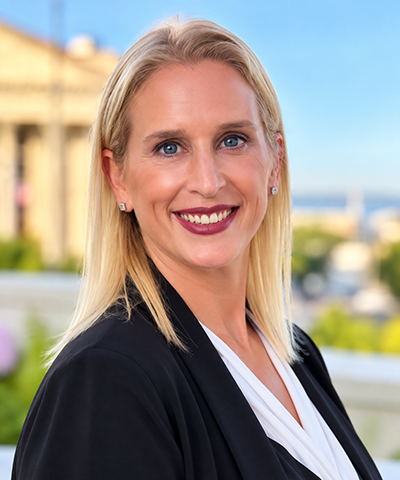 “Achieving those really gives us strategic and operational advantages,” she said. “It shows that we've met all of the required cybersecurity controls and helps demonstrate to federal customers that our cybersecurity posture is strong.”
Resiliency takes center stage
Beyond cybersecurity, Wyatt-Swanson said resiliency and continuity of operations have emerged as major priorities for government agencies.
“For me, it's all about resiliency and having the ability to maintain systems and operational capacity in the event of major events,” she said. “Having that continuity of operations and resiliency really drives a lot of my conversations.”
That emphasis aligns with SGT's role as a security and smart-facility integrator serving federal customers. While the company continues to deploy Siemens technologies, it also integrates third-party physical security, building automation and infrastructure systems.
“We now have the capability to integrate other products and truly act as an integrator for physical security products, as well as building automation solutions and other building technologies,” Wyatt-Swanson said.
Security and IT continue to converge
Wyatt-Swanson said one of the most significant shifts in recent years has been the convergence of physical security and information technology.
“Historically, security projects were largely managed by facilities teams,” she said. “Now those systems touch networks and servers, so you're seeing much closer alignment with IT organizations.”
As a result, agencies are increasingly evaluating physical security projects through a cybersecurity lens. She expects that trend to continue as artificial intelligence (AI) becomes more prevalent throughout government environments.
“Every product seems to have an AI component today,” Wyatt-Swanson said. “We're still learning how those technologies will interact and how organizations will govern them.”
Demand grows for smart-facility solutions
Among the technologies attracting the most interest from federal customers are digital twin technology, factory optimization and integrated smart-facility platforms.
Those solutions bring together technologies such as electronic security, utility monitoring, HVAC controls and building automation into a unified operating environment designed to improve efficiency and reduce costs.
SGT leverages Siemens' engineering, automation and digitalization expertise to address those challenges, taking what Wyatt-Swanson described as a holistic approach to customer requirements.
“We really try to understand what problem we're trying to solve,” she said. “Then we use our engineering expertise, technologies and resources to develop the best solution possible.”
Looking ahead
Wyatt-Swanson sees significant opportunities tied to federal modernization initiatives, smart-facility deployments and emerging technologies across defense and critical infrastructure sectors.
She said growing demand for integrated systems, stronger cybersecurity requirements and increased emphasis on operational resilience will continue shaping federal procurement decisions in the years ahead.
“We're also seeing continued demand for solutions that integrate building automation, utility monitoring, HVAC, lighting controls and electronic security into one system,” Wyatt-Swanson said.
After nearly 20 years in the industry, Wyatt-Swanson remains optimistic about the opportunities ahead for both federal customers and security providers.
“This industry is constantly evolving,” she said. “It's exciting to look to the future and see all the innovation on the horizon.”
Related: Siemens, TD SYNNEX form global partnership to advance IT/OT convergence

Comments