Facial recognition foes, industry clash over NYC bill

By Cory Harris, Editor
Updated 12:02 PM CDT, Wed August 26, 2026
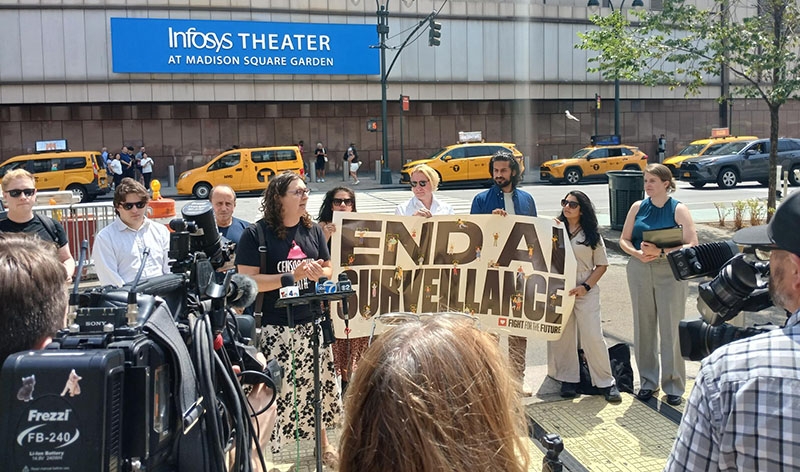
NEW YORK—A renewed push to ban facial recognition and other biometric technologies is fueling debate between privacy advocates and the security industry as New York City lawmakers consider legislation that would significantly restrict the use of biometric data.
The proposed measure, Intro. 213, gained momentum following an Aug. 14 rally outside Madison Square Garden, where lawmakers and privacy advocates urged the City Council to pass what supporters call the "Ban the Scan" bill.
 Supporters say the legislation would protect New Yorkers from intrusive surveillance, while opponents warn it could eliminate security, authentication and access control applications.
Privacy advocates push for broad restrictions
For the Surveillance Technology Oversight Project (STOP), one of the groups backing the legislation, the issue goes far beyond Madison Square Garden.
“The Ban the Scan package of legislation is designed to address the creep of facial recognition and other biometric surveillance across New York City and the vast expansion of this invasive technology in the everyday life of the city,” said Will Owen, deputy director of STOP.
Owen said Madison Square Garden has become the public face of the issue because of several high-profile incidents, including the 2022 case in which a lawyer was denied entry to Radio City Music Hall because her law firm was involved in litigation against MSG.
“That episode really sounded the alarm across New York City in terms of how facial recognition can be abused,” Owen said.
Owen argued that concerns about privacy, data collection, bias and false identifications are interconnected and cannot be resolved through regulation alone.
Industry warns of unintended consequences
 The Security Industry Association (SIA), however, contends that the legislation reaches far beyond facial recognition and would affect numerous biometric technologies used for security, authentication and access control.
Jake Parker, SIA’s senior director of government relations, described the proposal as one of the broadest biometric restrictions currently under consideration.
“It would literally ban business entity use of biometrics for almost any commercial purpose,” Parker said. “We’re talking about not just facial recognition. We’re talking about fingerprint technology and other voice-recognition technologies.”
According to Parker, the proposal could affect applications used in financial services, mobile authentication and building access control systems.
“It would be unlike any policy anywhere in the world as far as how restrictive it would be,” he said.
Rather than an outright ban, SIA advocates transparency, accountability and responsible use of the technology. Parker noted that New York City already requires businesses using biometric technology to provide notice through signage and said additional safeguards can address privacy concerns without prohibiting beneficial uses.
“It's not targeted to specific use cases of concern or specific abuses, it's just a total flat-out ban on biometric technologies,” Parker said.
Two competing visions
The dispute reflects two fundamentally different views of biometric technology's role in society.
Privacy advocates argue facial recognition and other biometric tools create unacceptable surveillance, privacy and discrimination risks. Industry groups contend the technologies can improve security, authentication and convenience when deployed with appropriate safeguards and oversight.
“We’re really at a tipping point where this technology is expanding so rapidly and becoming such a part of everyday American life,” Owen said. “We’re determined to ensure that we halt the rapid expansion of the surveillance dragnet.”
Related: Privacy advocates, lawmakers rally outside MSG in support of ‘Ban the Scan’ bill
Photo courtesy of Fight for the Future

Comments