Hill Day wake-up call: TMA rallies Congress on spectrum, safety and security

By Cory Harris, Editor
Updated 9:31 AM CDT, Wed March 11, 2026

WASHINGTON — From a looming 900 MHz spectrum reallocation that could disrupt millions of life‑safety devices to stalled federal school security funding and rising questions around artificial intelligence (AI), the security industry arrived on Capitol Hill March 4–5 with a clear message: Key federal decisions are putting core public‑safety infrastructure at risk.
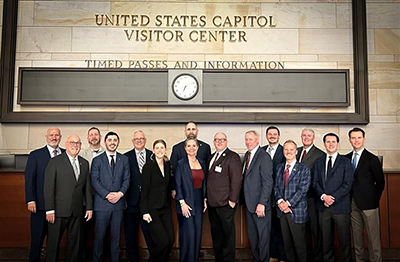 Leaders from The Monitoring Association (TMA), the Security Industry Association (SIA) and Electronic Security Association (ESA) participate in more than 55 meetings during Security Hill Day. For TMA President Alan Gillmore, the event delivered clarity, urgency and a renewed sense of the industry’s collective strength.
“There’s definitely a feeling of receptivity,” Gillmore said following the meetings. “People seemed very open. They wanted to hear what our industry was doing. They were very thirsty for information.”
Protecting the 900 MHz band – A ‘catastrophic cascade effect’
TMA raised awareness of several pressing issues. But none commanded more attention than the Federal Communications Commission (FCC) petition affecting the lower 900 MHz spectrum, a foundational band supporting millions of security and life safety devices. Gillmore said the spectrum issue dominated discussions – and for good reason.
“The vast majority of our wireless sensors live in that spectrum,” he explained.
Granting a single private entity the ability to license and potentially sublicense that band to broadband carriers could introduce widespread interference. The impact, Gillmore noted, would be immediate and far reaching for wireless smoke and carbon monoxide detectors; panic buttons; Z-Wave devices, thermostats, and home automation; RFID tags and tolling systems; and public safety traffic.
“It could cause the devices not to work where you think it’s working, but it’s not really working when you need it to work,” he emphasized.
Replacing that installed base of equipment would be what he called a “Herculean task.” “There’s not enough manpower and I don’t even know how manufacturers would source and manufacture that much equipment,” he said.
While TMA supports the national goal of redundant GPS capabilities, Gillmore noted that only one of 14 companies exploring options is requesting this spectrum.
“There are alternatives that would not cause this sort of catastrophic cascade effect,” he said. “We urge taking a broader perspective.”
School safety and life safety funding
School security – including funding for physical upgrades, gunshot detection and modernized systems – was another key talking point.
“School safety – that’s an easy one to get behind,” Gillmore said.
He urged lawmakers to protect and expand existing grant mechanisms so districts can continue modernizing life safety infrastructure.
AI: Responsible innovation takes center stage
AI remained an area of curiosity and caution among legislators. “They were kind of where we are,” Gillmore said. “Everybody is saying they’re using AI. Everyone’s jumping in feet first.”
TMA encouraged responsible, ethical adoption that enhances – rather than replaces – human monitoring roles. “It’s a force multiplier,” he said. “But we still need that human component to shepherd it in the right direction.”
A unified industry message
Gillmore emphasized the importance of coordinated advocacy amongst the industry associations.
“These kinds of events bring all the organizations together, speaking with one voice,” he said. “It was very well orchestrated. Huge thanks to SIA, ESA, and the TMA team.”
What’s next: Awareness, pressure, and persistence
TMA and the Alarm Industry Communications Committee (AICC) – a committee composed of representatives of TMA, SIA, ESA and major alarm companies and manufacturers – have already begun follow-up meetings, and the association plans to expand advocacy efforts into 2026 and beyond.
“The more we can do early on, the better the result will be,” Gillmore said. “It further fuels our fire for the fight.”

Comments